Showing posts with label MDIS. Show all posts

Thursday, May 3, 2012

Spectral Web


The top image is a MASCS VIRS instrument color composite over a region of cratered plains on Mercury that includes craters Mena (upper left), Cezanne, Philoxenus, Chu Ta, and the unnamed "blue tongue" impact crater (lower right). Below is a contrast enhanced version of the MDIS mosaic without the VIRS overlay. In the VIRS color composite, the young rays of Mena and the blue tongue crater appear in yellows and oranges. Other colors in the VIRS composite are related to degree of space weathering and iron content of the surface materials.

Date Created: April 24, 2012
Instruments: Visible and Infrared Spectrograph (VIRS) of the Mercury Atmosphere and Surface Composition Spectrometer (MASCS), and Mercury Dual Imaging System (MDIS)
VIRS Color Composite Wavelengths: 575 nm as red, 415 nm/750 nm as green, 310 nm/390 nm as blue
Center Latitude: -4.5°
Center Longitude: 244.7° E
Resolution: 1 km/pixel
Scale: Crater Mena (upper left of mosaics) is 15 km (9 mi) across

Image credit: NASA/Johns Hopkins University Applied Physics Laboratory/Carnegie Institution of Washington

Thursday, July 14, 2011

A Colorful Mood


This image highlights some of the color features present on Mercury's surface, such as Low Reflectance Material (LRM) and crater rays. Visible in the top left quadrant of this image is the named crater Moody, which has a prominent orange color on its floor in this enhanced color image.

This image was acquired as part of MDIS's color base map. The color base map is composed of WAC images taken through eight different narrow-band color filters and will cover more than 90% of Mercury's surface with an average resolution of 1 kilometer/pixel (0.6 miles/pixel). The highest-quality color images are obtained for Mercury's surface when both the spacecraft and the Sun are overhead, so these images typically are taken with viewing conditions of low incidence and emission angles.

Date acquired: July 03, 2011
Image Mission Elapsed Time (MET): 218154838, 218154854, 218154834
Image ID: 456233, 456237, 456232
Instrument: Wide Angle Camera (WAC) of the Mercury Dual Imaging System (MDIS)
WAC filter: 9 (1000 nanometers), 7 (750 nanometers), 6 (430 nanometers) as red-green-blue
Center Latitude: -30.86°
Center Longitude: 149.5° E
Resolution: 1712 meters/pixel
Scale: Moody crater is 83 km (~51.5 mi.) in diameter
Incidence Angle: 32.6°
Emission Angle: 0.5°
Phase Angle: 32.8°

Photo credit: NASA/Johns Hopkins University Applied Physics Laboratory/Carnegie Institution of Washington

Thursday, January 27, 2011

Mercury in Color


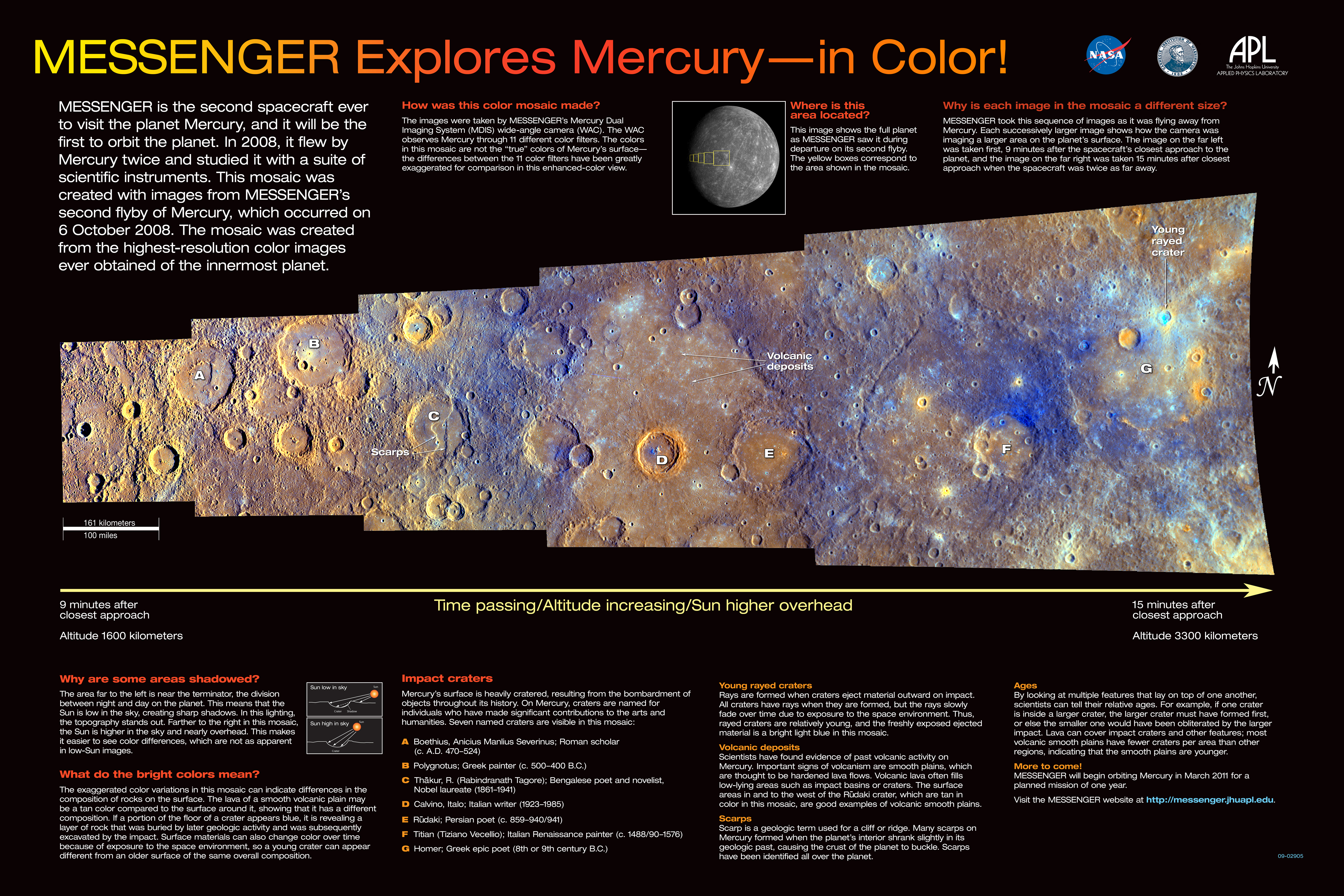
During MESSENGER's second flyby of Mercury, MDIS acquired a strip of high-resolution images obtained with each of the WAC's 11 different color filters. The graphic shown here displays the resulting enhanced-color mosaic and gives considerable detail about the images, how the mosaic was created, and the geologic features that can be seen.

Currently, these images are the highest-resolution color images ever obtained of the Solar System's innermost planet, but not for long! On March 18, 2011, MESSENGER will enter into orbit about Mercury, and the mission's extensive, year-long science observation campaign will begin. That campaign includes capturing color images of Mercury's surface at higher resolution than ever before.

Special thanks to Kathryn Powell, a summer intern student with the MESSENGER project, for contributing to the content of this graphic. Note: since the original creation of this graphic, the crater identified in the upper right with the label "young rayed crater" has been named Dominici. See PIA12871 to learn more about this recently named crater.

Date Acquired: October 6, 2008
Instrument: Wide Angle Camera (WAC) of the Mercury Dual Imaging System (MDIS)

Photo credit: NASA/Johns Hopkins University Applied Physics Laboratory/Carnegie Institution of Washington

Note: There is a very nice annotated poster of this image located here.

Thursday, December 9, 2010

The Rays of Hokusai Crater


This mosaic of NAC images shows the impact crater Hokusai, located on Mercury at a latitude of 58° North. The crater has an impressive system of rays, which extend as much as a thousand kilometers (more than 600 miles) across the planet and are the longest that have yet been identified on Mercury.

Such rays are formed when an impact excavates material from beneath the surface and throws that material outward from the crater. These bright rays, consisting of both ejecta and secondary craters that form when the ejected material re-impacts the surface, slowly begin to fade as they are exposed to the harsh space environment. Mercury and other airless planetary bodies are being constantly bombarded with micrometeoroids and energetic ions, producing an effect known as space weathering. Craters with bright rays are thought to be relatively young because the rays are still visible, indicating that they have had less exposure to such weathering processes than craters that lack rays.

Although the extent of some of Hokusai's rays have been determined, images acquired during MESSENGER's three Mercury flybys have not yet shown all of Hokusai's rays. During MESSENGER's orbital observations, which will begin in March 2011, MDIS will acquire high-resolution color images of Mercury's entire surface. This global color map will allow the full extent of the extensive systems of rays emanating from Hokusai and other young craters to be mapped for the first time.

Date Acquired: October 6, 2008
Instrument: Narrow Angle Camera (NAC) of the Mercury Dual Imaging System (MDIS)
Scale: The diameter of Mercury is 4,880 kilometers (3030 miles). Hokusai has a diameter of 95 kilometers (59 miles)

Photo credit: NASA/Johns Hopkins University Applied Physics Laboratory/Carnegie Institution of Washington