Showing posts with label MESSENGER 2nd Flyby. Show all posts

Thursday, September 19, 2013

Rembrandt's Rim


The Rembrandt basin, first discovered during MESSENGER's second flyby of Mercury, is the youngest of the large impact basins that formed on Mercury. Here you can see a portion of the rim. The rim scarp runs north-south along the scene, casting a meandering shadow that separates the basin exterior on the left from the interior on the right. The two sides don't look hugely different, likely because during and after the basin-forming event molten rock coated much of this area, later solidifying to form the surface we see today.

This image was acquired as a targeted set of stereo images. Targeted stereo observations are acquired at resolutions much higher than that of the 200-meter/pixel stereo base map. These targets acquired with the NAC enable the detailed topography of Mercury's surface to be determined for a local area of interest.

Date acquired: August 14, 2013
Image Mission Elapsed Time (MET): 18791579
Image ID: 4630071
Instrument: Narrow Angle Camera (NAC) of the Mercury Dual Imaging System (MDIS)
Center Latitude: -33.54°
Center Longitude: 77.82° E
Resolution: 104 meters/pixel
Scale: This scene is approximately 106 km (66 mi.) across
Incidence Angle: 79.3°
Emission Angle: 2.8°
Phase Angle: 76.7°

Photo credit: NASA/Johns Hopkins University Applied Physics Laboratory/Carnegie Institution of Washington

Thursday, March 15, 2012

Derain Crater


This image, taken with the Wide Angle Camera (WAC), gives us a close-up look at Derain crater. Named for the twentieth century French artist André Derain, this crater was first viewed during MESSENGER's second flyby. Its unique dark collar is made up of low-reflectance material (LRM) exposed during the impact that formed the crater; this material is some of the darkest identified on Mercury and may have a mineralogical composition that is different from the surrounding terrain.

Date acquired: February 10, 2012
Image Mission Elapsed Time (MET): 237382607
Image ID: 1377852
Instrument: Wide Angle Camera (WAC) of the Mercury Dual Imaging System (MDIS)
WAC filter: 5 (628 nanometers)
Center Latitude: -8.97°
Center Longitude: 19.19° E
Resolution: 501 meters/pixel
Scale: Derain crater is 190 km (118 miles) in diameter
Incidence Angle: 8.9°
Emission Angle: 51.4°
Phase Angle: 55.1°

Photo credit: NASA/Johns Hopkins University Applied Physics Laboratory/Carnegie Institution of Washington

Sunday, February 12, 2012

De Graft Crater


De Graft crater was named for 20th century Ghanaian playwright, poet, and novelist Joe de Graft following MESSENGER's second flyby of the innermost planet. De Graft is a complex crater that hosts numerous bright hollows on its floor. This image is a mosaic of three NAC images taken as a sequence designed to target the crater.

Date acquired: January 23, 2012
Image Mission Elapsed Time (MET): 235766888, 235766929, 235766969
Image ID: 1300010, 1300011, 1300012
Instrument: Narrow Angle Camera (NAC) of the Mercury Dual Imaging System (MDIS)
Center Latitude: 21.90°
Center Longitude: 1.78° E
Resolution: 57 meters/pixel
Scale: De Graft crater is approximately 68 km (42 mi.) in diameter.
Incidence Angle: 73.5°
Emission Angle: 37.1°
Phase Angle: 110.7°

Photo credit: NASA/Johns Hopkins University Applied Physics Laboratory/Carnegie Institution of Washington

Thursday, August 18, 2011

Rembrandt Revisited


This limb image shows Rembrandt, the second largest impact basin on Mercury after Caloris. Discovered during the second MESSENGER flyby, Rembrandt is one of the youngest impact basins on Mercury, as indicated by the relatively low density of impact craters on its rim. A large lobate scarp trending from the southwest to the north crosscuts Rembrandt and several of the smaller craters that have impacted the smooth interior plains.

Date acquired: August 07, 2011
Image Mission Elapsed Time (MET): 221198580
Image ID: 601688
Instrument: Wide Angle Camera (WAC) of the Mercury Dual Imaging System (MDIS)
WAC filter: 7 (748 nanometers)
Center Latitude: -32.95°
Center Longitude: 84.90° E
Resolution: 1756 meters/pixel
Scale: The large impact basin is ~715 km (444 mi) in diameter.
Incidence Angle: 46.3°
Emission Angle: 48.7°
Phase Angle: 95.0°

Photo credit: NASA/Johns Hopkins University Applied Physics Laboratory/Carnegie Institution of Washington

Thursday, January 27, 2011

Mercury in Color


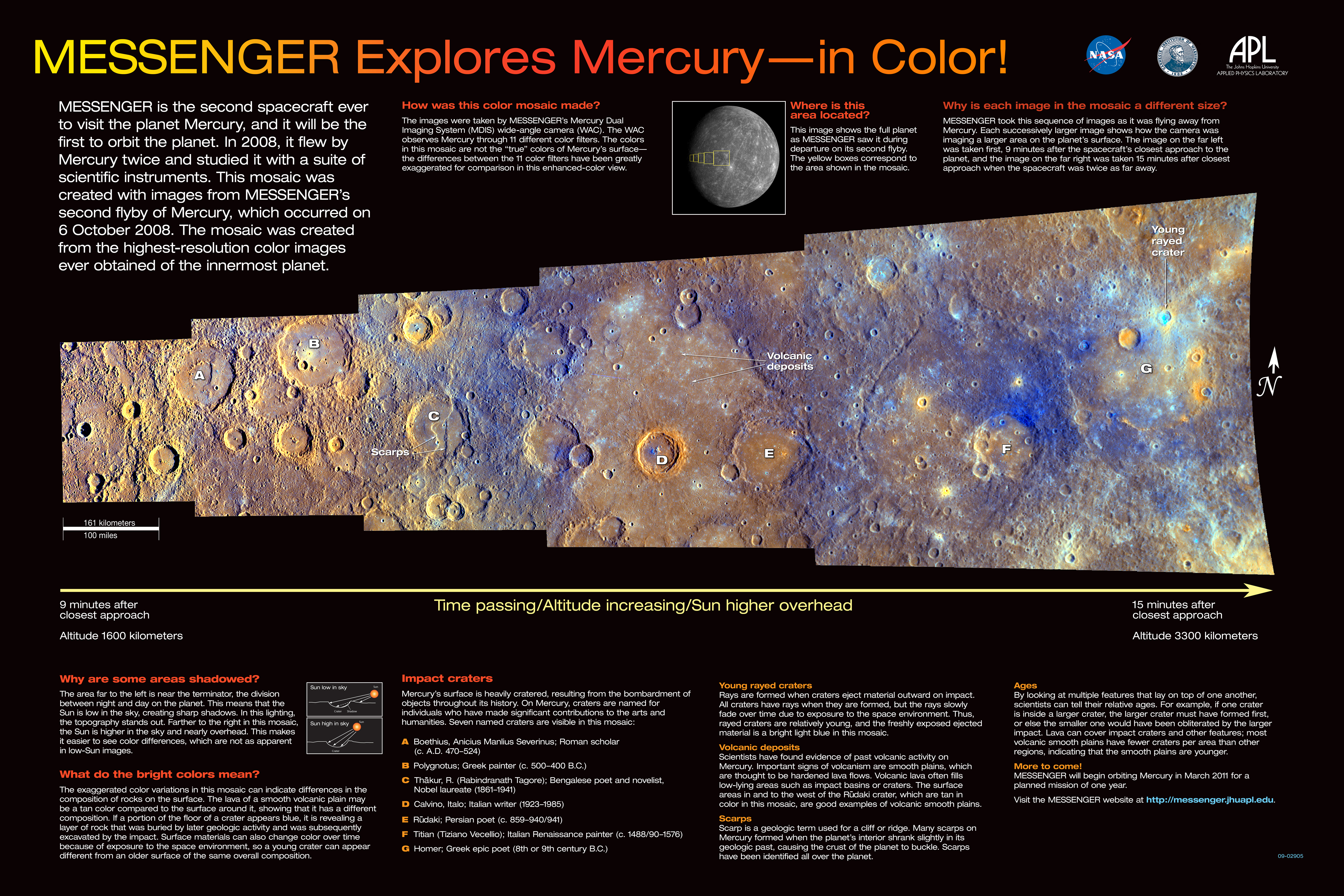
During MESSENGER's second flyby of Mercury, MDIS acquired a strip of high-resolution images obtained with each of the WAC's 11 different color filters. The graphic shown here displays the resulting enhanced-color mosaic and gives considerable detail about the images, how the mosaic was created, and the geologic features that can be seen.

Currently, these images are the highest-resolution color images ever obtained of the Solar System's innermost planet, but not for long! On March 18, 2011, MESSENGER will enter into orbit about Mercury, and the mission's extensive, year-long science observation campaign will begin. That campaign includes capturing color images of Mercury's surface at higher resolution than ever before.

Special thanks to Kathryn Powell, a summer intern student with the MESSENGER project, for contributing to the content of this graphic. Note: since the original creation of this graphic, the crater identified in the upper right with the label "young rayed crater" has been named Dominici. See PIA12871 to learn more about this recently named crater.

Date Acquired: October 6, 2008
Instrument: Wide Angle Camera (WAC) of the Mercury Dual Imaging System (MDIS)

Photo credit: NASA/Johns Hopkins University Applied Physics Laboratory/Carnegie Institution of Washington

Note: There is a very nice annotated poster of this image located here.

Sunday, October 31, 2010

Long Scarp


Extending from the left edge of this image diagonally toward the lower right corner is a long scarp (cliff) face. This scarp runs through a large ancient crater in the center of the frame and was seen for the first time during MESSENGER's second Mercury flyby. Planetary geologists use the Latin term "rupes" for scarps on Mercury. Scarps such as this one have been identified all over the planet. The presence of many long and high scarps suggests a history for Mercury that is unlike that of any of the other planets in the Solar System. These giant scarps are believed to have formed when Mercury's interior cooled and the entire planet contracted slightly as a result, causing the surface rocks to fracture and some blocks of crust to thrust over others along great faults. Determining the geometry of such scarps on Mercury and information on the times that deformation occurred can thus be used to understand the thermal history of the planet. Next year, when the MESSENGER spacecraft is in orbit around Mercury, MDIS will acquire for the first time global imaging coverage of Mercury's surface with lighting conditions optimal for identifying such scarps.

Date Acquired: October 6, 2008
Instrument: Narrow Angle Camera (NAC) of the Mercury Dual Imaging System (MDIS)
Scale: The large crater crosscut by the scarp is approximately 110 kilometers (70 miles) in diameter.

Photo credit: NASA/Johns Hopkins University Applied Physics Laboratory/Carnegie Institution of Washington