Wednesday, March 26, 2014

Rim of an Unnamed Crater


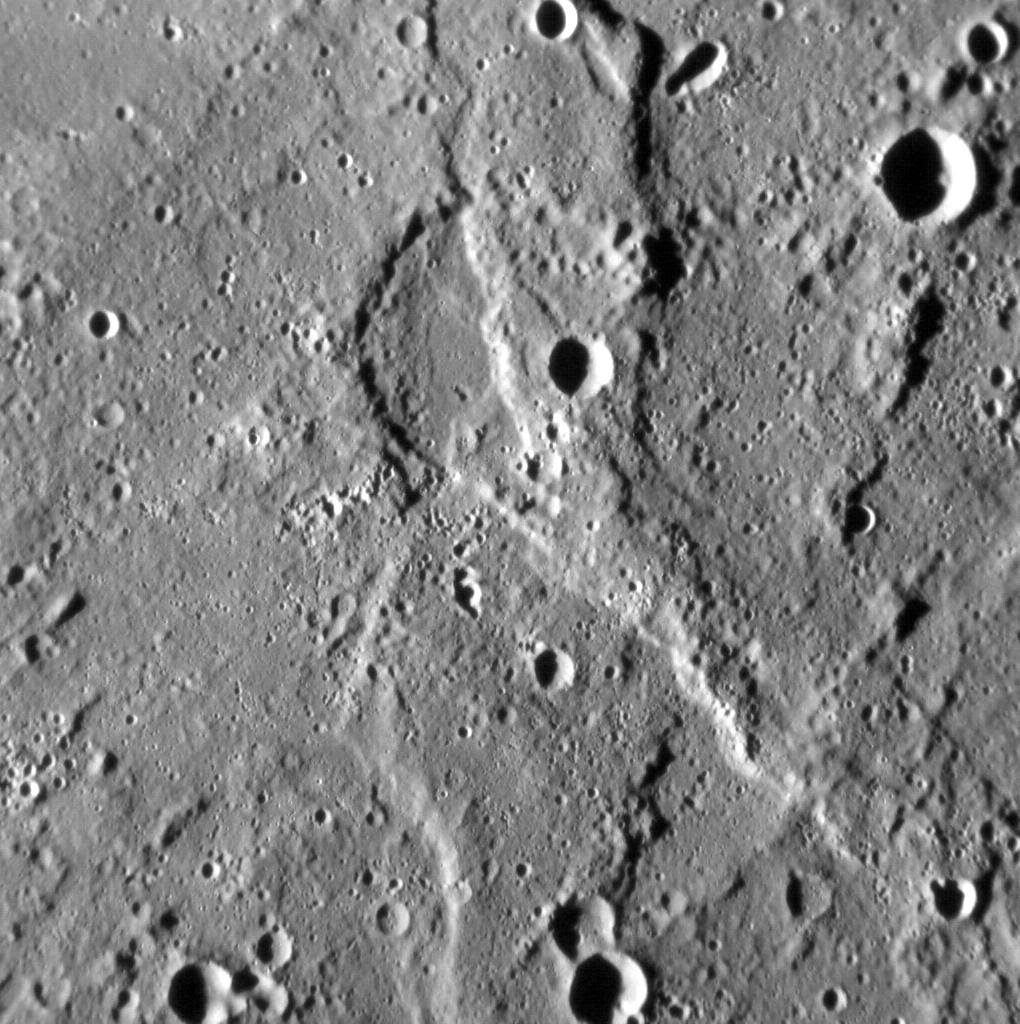
This stunning image shows a portion of the sharp rim of an unnamed, ~28 km (17 mile) diameter complex crater. The upper right portion of the image lies outside of the crater, and the lower left portion of the image lies on the crater floor. The crater at the center of the image lies on the crater wall. North is to the right.

This image was acquired as a high-resolution targeted observation. Targeted observations are images of a small area on Mercury's surface at resolutions much higher than the 200-meter/pixel morphology base map. It is not possible to cover all of Mercury's surface at this high resolution, but typically several areas of high scientific interest are imaged in this mode each week.

Date acquired: March 14, 2014
Image Mission Elapsed Time (MET): 37087259
Image ID: 5930668
Instrument: Narrow Angle Camera (NAC) of the Mercury Dual Imaging System (MDIS)
Center Latitude: 78.14°
Center Longitude: 278.3° E
Resolution: 16 meters/pixel
Scale: This image is approximately 10.5 km (6.5 mi.) across.
Incidence Angle: 78.4°
Emission Angle: 39.7°
Phase Angle: 118.1°

Photo credit: NASA/Johns Hopkins University Applied Physics Laboratory/Carnegie Institution of Washington

Saturday, March 22, 2014

Mercury by Messenger's MASCS and VIRS Instruments


The Sun's light provides a powerful tool for understanding the composition of materials in the Solar System. Today's image features two views of Mercury provided by the Mercury Atmospheric and Surface Composition Spectrometer (MASCS) instrument. As the Sun's light hits the surface of Mercury, the Visible and Infrared Spectrograph (VIRS) portion of MASCS measures many wavelengths of the reflected light from a single spot on the surface at a time. These observations create a spectral profile of the surface as MESSENGER orbits Mercury. In each panel, the top left corner of the image is 70°N,180°E and the bottom right corner is 70°S,180°E. Most of Caloris basin can be seen along the right edge of each panel. The top panel is a monochromatic image of the interpolated 750 nm reflectance, and the bottom panel shows the same data but in a false color composite selected to highlight compositional variations on the surface.

The monochromatic map is part of a data set that was released to the public earlier this month through the Planetary Data System (PDS). In conjunction with the release, the team hosted a Data User's Workshop at the 45th Lunar and Planetary Science Conference, which is being held this week in The Woodlands, Texas.

Instruments: Visible and Infrared Spectrograph (VIRS) of the Mercury Atmosphere and Surface Composition Spectrometer (MASCS)
Center Latitude:
Center Longitude: 0° E
Map Projection: Simple Cylindrical
VIRS Monochromatic Wavelength: 750 nm
VIRS Color Composite Wavelengths: 575 nm as red, 415 nm/750 nm as green, 310 nm/390 nm as blue
Scale: Caloris Basin is 1,550 km (963 mi) across.

Image credit: NASA/Johns Hopkins University Applied Physics Laboratory/Carnegie Institution of Washington

Thursday, March 20, 2014

Geological Structure Map of Mercury


Scientists have known since Mariner 10 that Mercury has contracted. This contraction is a result of the cooling of Mercury's interior, and is the process responsible for the formation of the planet's wrinkle ridges and lobate scarps. For almost four decades, however, the amount of global contraction measured from spacecraft data has been substantially less than that predicted by models of the thermal evolution of Mercury.

Now, using global photogeological and topographic MESSENGER data of Mercury, members of the MESSENGER team have mapped almost 6,000 ridges and scarps across the planet. Today's image shows the result of this mapping work, with structures color-coded according to one of four classes. (The global photogeological and topographic data used in this study are shown in the bottom left and right, respectively, of the image.) With these results, the MESSENGER team has calculated that Mercury contracted to a much greater extent than had been determined previously from mapping -- by up to seven times more, in fact.

This study was published online in the journal Nature Geoscience on Sunday, March 16, 2014, and is being presented today in the "Mercury" session at the 45th Lunar and Planetary Science Conference, which is being held this week in The Woodlands, Texas. In total, MESSENGER team members are presenting 25 papers at this conference.

Date published online: March 16, 2014
Center Latitude:
Center Longitude: 0°E
Projection: Molleweide
Reference: Byrne et al. (2014) Mercury's global contraction much greater than earlier estimates, Nature Geoscience, doi:10.1038/NGEO2097

Map credit: NASA/Johns Hopkins University Applied Physics Laboratory/Carnegie Institution of Washington

Tuesday, March 18, 2014

Fault Scarp


New images obtained during low-altitude opportunities when the MESSENGER spacecraft is closest to the surface have revealed a small lobate scarp, identified here with white arrows. Cooling of Mercury's interior over billions of years has caused the planet to contract, forming a network of large landforms called lobate scarps, many over a kilometer high and hundreds of kilometers long. One of the goals for MESSENGER's current extended mission is to determine if there is evidence of young fault scarps that indicate recent contraction of Mercury due to interior cooling and continued solidification of the core. This scarp is only 2 km long, the shortest fault scarp yet found on Mercury. Landforms of this scale must be young, because small features will not survive for billions of years under constant meteoroid bombardment. Lobate scarps of the same scale found on the Moon are thought to be no more than 800 million years old and could be less than 50 million years old. Thus, this small scarp and others likely to be discovered in low-altitude images could provide evidence of very recent contraction of Mercury.

This image was acquired as a high-resolution targeted observation. Targeted observations are images of a small area on Mercury's surface at resolutions much better than that of the 200-meter/pixel morphology base map. It is not possible to cover all of Mercury's surface at this high resolution, but typically several areas of high scientific interest are imaged in this mode each week.

Date acquired: February 09, 2014
Image Mission Elapsed Time (MET): 34263837, 34263839
Image ID: 5729947, 5729948
Instrument: Narrow Angle Camera (NAC) of the Mercury Dual Imaging System (MDIS)
Center Latitude: 65.8°
Center Longitude: 64.8° E
Resolution: 17 meters/pixel
Scale: 2-kilometer (1.2-mile) scale bar shown on the image
Incidence Angle: 79.7°
Emission Angle: 33.5°
Phase Angle: 113.3°

Photo credit: NASA/Johns Hopkins University Applied Physics Laboratory/Carnegie Institution of Washington

Saturday, March 15, 2014

Berkel Crater


MESSENGER's first orbital image, the first ever obtained from a spacecraft in orbit about Mercury, showed a large region of the planet, including the crater Berkel. Monday will mark three years since the MESSENGER spacecraft entered into orbit about Mercury. Over 200,000 images have been captured since that first orbital view, including the striking image of Berkel shown here, which shows new details of Berkel's dark, low-reflectance material, excavated during the impact that formed the crater.

This image was acquired as part of the NAC ride-along imaging campaign. When data volume is available and MDIS is not acquiring images for its other campaigns, high-resolution NAC images are obtained of the surface. These images are designed not to interfere with other instrument observations but take full advantage of periods during the mission when extra data volume is available.

Date acquired: February 16, 2014
Image Mission Elapsed Time (MET): 34838972
Image ID: 5770878
Instrument: Narrow Angle Camera (NAC) of the Mercury Dual Imaging System (MDIS)
Center Latitude: -14.11°
Center Longitude: 26.85° E
Resolution: 41 meters/pixel
Scale: Berkel crater is 22 kilometers (14 miles) in diameter
Incidence Angle: 33.2°
Emission Angle: 48.4°
Phase Angle: 30.1°
Orientation: North is toward the bottom of this image.

Photo credit: NASA/Johns Hopkins University Applied Physics Laboratory/Carnegie Institution of Washington

Friday, March 14, 2014

Hollows in Sholem Aleichem Crater


This image, just captured last week, shows Mercury's hollows in the highest resolution yet achieved! These hollows are located on the wall of Sholem Aleichem, within a region of low-reflectance material.

This image was acquired as part of the MDIS low-altitude imaging campaign. During MESSENGER's second extended mission, the spacecraft makes a progressively closer approach to Mercury's surface than at any previous point in the mission, enabling the acquisition of high-spatial-resolution data. For spacecraft altitudes below 350 kilometers, NAC images are acquired with pixel scales ranging from 20 meters to as little as 2 meters.

Date acquired: March 07, 2014
Image Mission Elapsed Time (MET): 36539529
Image ID: 5891638
Instrument: Narrow Angle Camera (NAC) of the Mercury Dual Imaging System (MDIS)
Center Latitude: 51.90°
Center Longitude: 267.53° E
Resolution: 7.9 meters/pixel
Scale: This image is about 8 kilometers (5 miles) across
Incidence Angle: 63.2°
Emission Angle: 14.9°
Phase Angle: 78.0°

Photo credit: NASA/Johns Hopkins University Applied Physics Laboratory/Carnegie Institution of Washington

Tuesday, March 11, 2014

Detail From The New Three-Color Mosaic


A new color mosaic created from MESSENGER images is now available! This mosaic was part of a release on March 7, 2014 by NASA's Planetary Data System (PDS). A portion of the new color mosaic is shown here; can you find the craters Debussy, Derain, Berkel, and Warhol in this view? Explore the full 3-color mosaic (and confirm the locations of these craters) in QuickMap.

The images for MDIS's high-resolution 3-color mosaic were acquired during MESSENGER's second year in orbit about Mercury. The 3-color mosaic was designed to complement the 8-color base map acquired during MESSENGER's primary mission. By imaging Mercury's surface in a subset of the color filters at the highest resolution possible, the 3-color mosaic is available at 332 meters/pixel,as compared to 665 meters/pixel for the 8-color mosaic.

Instrument: Wide Angle Camera (WAC) of the Mercury Dual Imaging System (MDIS)
WAC filters: 9, 7, 6 (996, 748, 433 nanometers) in red, green, and blue
Center Latitude: -14.9°
Center Longitude: 10.3° E
Resolution: 332 meters/pixel
Scale: Derain has a diameter of 167 km (104 miles)
Projection: simple cylindrical

Image credit: NASA/Johns Hopkins University Applied Physics Laboratory/Carnegie Institution of Washington

Saturday, March 8, 2014

Odin Planitia and Schiaparelli Dorsum


On March 5 we saw an area to the west of Caloris. Today we travel to the east of the basin, another area that is thought to be related to ejecta from the Caloris basin impact event. The knobs and unusual corrugated texture are part of Odin Planitia and may have formed from ejecta and impact melt. Schiaparelli Dorsum, nearly aligned with the terminator (the division between the dayside and night side of the planet), cuts across the scene from top to bottom.

This image was acquired as part of MDIS's high-incidence-angle base map. The high-incidence-angle base map complements the surface morphology base map of MESSENGER's primary mission that was acquired under generally more moderate incidence angles. High incidence angles, achieved when the Sun is near the horizon, result in long shadows that accentuate the small-scale topography of geologic features. The high-incidence-angle base map was acquired with an average resolution of 200 meters/pixel.

Date acquired: July 07, 2012
Image Mission Elapsed Time (MET): 250134169
Image ID: 2154159
Instrument: Wide Angle Camera (WAC) of the Mercury Dual Imaging System (MDIS)
WAC filter: 7 (748 nanometers)
Center Latitude: 24.83°
Center Longitude: 195.2° E
Resolution: 228 meters/pixel
Scale: This scene is approximately 400 km (250 miles) across
Incidence Angle: 88.8°
Emission Angle: 53.2°
Phase Angle: 142.0°

Photo credit: NASA/Johns Hopkins University Applied Physics Laboratory/Carnegie Institution of Washington

Thursday, March 6, 2014

Caloris Basin Rim


Small knobs and crater rims just barely catch the sunlight with the Sun low on Mercury's eastern horizon. The relatively smooth floor of the Caloris basin is on the right, and the rim and exterior of the basin are to the left. The knobby texture outside of the basin may be the result of blocks of material that were ejected by the basin-forming impact.

This image was acquired as part of MDIS's high-incidence-angle base map. The high-incidence-angle base map complements the surface morphology base map of MESSENGER's primary mission that was acquired under generally more moderate incidence angles. High incidence angles, achieved when the Sun is near the horizon, result in long shadows that accentuate the small-scale topography of geologic features. The high-incidence-angle base map was acquired with an average resolution of 200 meters/pixel.

Date acquired: April 27, 2012
Image Mission Elapsed Time (MET): 244054579
Image ID: 1721895
Instrument: Wide Angle Camera (WAC) of the Mercury Dual Imaging System (MDIS)
WAC filter: 7 (748 nanometers)
Center Latitude: 40.19°
Center Longitude: 140.5° E
Resolution: 270 meters/pixel
Scale: This scene is approximately 492 km (306 miles) across
Incidence Angle: 88.2°
Emission Angle: 53.7°
Phase Angle: 142.0°

Photo credit: NASA/Johns Hopkins University Applied Physics Laboratory/Carnegie Institution of Washington

Tuesday, March 4, 2014

Abedin Crater Wall


The beautiful Abedin crater is featured in today's image. The crater's sunlit wall meets the crater floor, which occupies the left side of the scene. The floor is largely covered with rock that was melted by the Abdedin impact, ponded on the crater floor, and has now solidified, cracking as it cooled.

This image was acquired as a high-resolution targeted observation. Targeted observations are images of a small area on Mercury's surface at resolutions much higher than the 200-meter/pixel morphology base map. It is not possible to cover all of Mercury's surface at this high

Date acquired: September 23, 2013
Image Mission Elapsed Time (MET): 22252071
Image ID: 4875876
Instrument: Narrow Angle Camera (NAC) of the Mercury Dual Imaging System (MDIS)
Center Latitude: 62.28°
Center Longitude: 352.0° E
Resolution: 16 meters/pixel
Scale: Abedin crater is 116 km (72 miles) in diameter
Incidence Angle: 83.6°
Emission Angle: 22.1°
Phase Angle: 105.8°

Photo credit: NASA/Johns Hopkins University Applied Physics Laboratory/Carnegie Institution of Washington

Saturday, March 1, 2014

Graben from Pantheon Fossae


A series of troughs extends diagonally (southwest-northeast) across this high-resolution image of the interior of the Caloris basin. The troughs are graben: structures that developed where horizontal forces pulled the crust apart, causing valleys to form as sections of rock dropped down between two inward-dipping faults. Pulling-apart ("extensional") deformation is much less common on Mercury than is compressional deformation. However, a large number of graben are found within Caloris. This network of graben, named Pantheon Fossae, is the subject of a blog essay recently posted on the website of The Planetary Society.

This image was acquired as a high-resolution targeted observation. Targeted observations are images of a small area on Mercury's surface at resolutions much higher than the 200-meter/pixel morphology base map. It is not possible to cover all of Mercury's surface at this high resolution, but typically several areas of high scientific interest are imaged in this mode each week.

Date acquired: January 19, 2012
Image Mission Elapsed Time (MET): 235472082
Image ID: 1285755
Instrument: Narrow Angle Camera (NAC) of the Mercury Dual Imaging System (MDIS)
Center Latitude: 27.3°
Center Longitude: 160.7° E
Resolution: 24 meters/pixel
Scale: The scene is about 43 km (27 mi.) across
Incidence Angle: 76.8°
Emission Angle: 54.9°
Phase Angle: 131.8°
North is up in this image.

Photo credit: NASA/Johns Hopkins University Applied Physics Laboratory/Carnegie Institution of Washington

Thursday, February 27, 2014

Small Impact Craters


The Sun was barely above the horizon when this image was obtained, and the strong shadows emphasize the ruggedness of the terrain. The surface appears to be almost completely covered by -- or saturated with -- relatively small impact craters (about 2 to 3 km in diameter). Many of these may be secondary craters from a large impact in the vicinity, but it is difficult to tell from which one these small craters originate.

This image was acquired as part of MDIS's high-resolution surface morphology base map. The surface morphology base map covers more than 99% of Mercury's surface with an average resolution of 200 meters/pixel. Images acquired for the surface morphology base map typically are obtained at off-vertical Sun angles (i.e., high incidence angles) and have visible shadows so as to reveal clearly the topographic form of geologic features.

Date acquired: January 05, 2012
Image Mission Elapsed Time (MET): 234240885
Image ID: 1226465
Instrument: Wide Angle Camera (WAC) of the Mercury Dual Imaging System (MDIS)
WAC filter: 7 (748 nanometers)
Center Latitude: 77.7°
Center Longitude: 214.9° E
Resolution: 137 meters/pixel
Scale: The scene is about 88 km (55 mi.) wide
Incidence Angle: 88.4°
Emission Angle: 39.7°
Phase Angle: 128.1°
North is up in this image.

Photo credit: NASA/Johns Hopkins University Applied Physics Laboratory/Carnegie Institution of Washington

Sunday, February 16, 2014

Kosho Crater at Sunset


This image crosses the terminator, the transition between day and night. An observer located on Kosho's illuminated central peak at the time this image was taken would see the sun setting over the horizon. This image, which shows the area just to the north of Kosho, was taken immediately before the image featured here.

This image was acquired as part of MDIS's high-incidence-angle base map. The high-incidence-angle base map complements the surface morphology base map of MESSENGER's primary mission that was acquired under generally more moderate incidence angles. High incidence angles, achieved when the Sun is near the horizon, result in long shadows that accentuate the small-scale topography of geologic features. The high-incidence-angle base map was acquired with an average resolution of 200 meters/pixel.

Date acquired: December 09, 2013
Image Mission Elapsed Time (MET): 28935228
Image ID: 5350994
Instrument: Wide Angle Camera (WAC) of the Mercury Dual Imaging System (MDIS)
WAC filter: 7 (748 nanometers)
Center Latitude: 60.08°
Center Longitude: 223.9° E
Resolution: 166 meters/pixel
Scale: Kosho crater is ~65 km (40 mi.) in diameter.
Incidence Angle: 91.6°
Emission Angle: 50.4°
Phase Angle: 142.0°

Photo credit: NASA/Johns Hopkins University Applied Physics Laboratory/Carnegie Institution of Washington

Friday, February 14, 2014

Ghost Crater Near Suisei Planitia


This image features a ghost crater ~55 km (34 mi.) in diameter near its center. The crater was likely flooded by the lava that formed the Suisei Planitia. The crater rim and central peaks can still be seen, despite their burial, and the area was showered by secondary craters from a subsequent impact event.

This image was acquired as part of MDIS's high-incidence-angle base map. The high-incidence-angle base map complements the surface morphology base map of MESSENGER's primary mission that was acquired under generally more moderate incidence angles. High incidence angles, achieved when the Sun is near the horizon, result in long shadows that accentuate the small-scale topography of geologic features. The high-incidence-angle base map was acquired with an average resolution of 200 meters/pixel.

Date acquired: December 09, 2013
Image Mission Elapsed Time (MET): 28935167
Image ID: 5350993
Instrument: Wide Angle Camera (WAC) of the Mercury Dual Imaging System (MDIS)
WAC filter: 7 (748 nanometers)
Center Latitude: 63.17°
Center Longitude: 219.7° E
Resolution: 157 meters/pixel
Scale: The ghost crater near the center of the image is approximately 55 km (34 mi.) in diameter.
Incidence Angle: 89.6°
Emission Angle: 52.4°
Phase Angle: 142.0°

Photo credit: NASA/Johns Hopkins University Applied Physics Laboratory/Carnegie Institution of Washington

Tuesday, February 11, 2014

Dürer Peak-Ring Basin


This image, taken at a high emission angle, helps the eye to see the three-dimensional nature of the scene. Dürer, a peak-ring basin, can be seen in the foreground. Dürer's peak ring is dotted with hollows. North is to the left in this image.

This image was acquired as part of MDIS's high-incidence-angle base map. The high-incidence-angle base map complements the surface morphology base map of MESSENGER's primary mission that was acquired under generally more moderate incidence angles. High incidence angles, achieved when the Sun is near the horizon, result in long shadows that accentuate the small-scale topography of geologic features. The high-incidence-angle base map was acquired with an average resolution of 200 meters/pixel.

Date acquired: November 16, 2013
Image Mission Elapsed Time (MET): 26946160
Image ID: 5209643
Instrument: Wide Angle Camera (WAC) of the Mercury Dual Imaging System (MDIS)
WAC filter: 7 (748 nanometers)
Center Latitude: 20.68°
Center Longitude: 244.9° E
Resolution: 236 meters/pixel
Scale: Dürer basin is approximately 195 km (121 mi.) in diameter.
Incidence Angle: 67.1°
Emission Angle: 62.9°
Phase Angle: 30.0°

Photo credit: NASA/Johns Hopkins University Applied Physics Laboratory/Carnegie Institution of Washington

Friday, February 7, 2014

Hollows in a Layer of an Impact Crater


MESSENGER has now surpassed 200,000 images acquired from orbit about Mercury! And there are still many more to come. In particular, acquiring NAC images when the spacecraft is closest to the planet is a priority for the remainder of the mission; such images will allow the highest resolution views of Mercury's surface to be captured. The four-image mosaic shown here is one of the first from the MDIS low-altitude imaging campaign. Among the details revealed are hollows that appear to have formed in one layer in the wall of this 15-kilometer-diameter crater.

This image was acquired as part of the MDIS low-altitude imaging campaign. During MESSENGER's second extended mission, the spacecraft makes a progressively closer approach to Mercury's surface than at any previous point in the mission, enabling the acquisition of high-spatial-resolution data. For spacecraft altitudes below 350 kilometers, NAC images are acquired with pixel scales ranging from 20 meters to as little as 2 meters.

Date acquired: December 05, 2013
Image Mission Elapsed Time (MET): 28560063, 65, 67, 69
Image ID: 5324381-84
Instrument: Narrow Angle Camera (NAC) of the Mercury Dual Imaging System (MDIS)
Center Latitude: 72.4°
Center Longitude: 124.9° E
Resolution: 16 meters/pixel
Scale: The height and width of each image is 8.5 kilometers (5.3 miles)
Incidence Angle: 73.4°
Emission Angle: 10.8°
Phase Angle: 81.9°

Photo credit: NASA/Johns Hopkins University Applied Physics Laboratory/Carnegie Institution of Washington

Thursday, February 6, 2014

Hollows in an Unnamed Impact Crater


Today's image features the central peak complex of a large, unnamed crater on the plains surrounding the Caloris basin, roughly 400 km (250 mi) northwest of the crater Munch. The image has been stretched to highlight the details of the hollows that are forming on the crests of the peaks. The bright hollows on Mercury stand out in stark contrast to the low reflectance material with which they are frequently associated.

This image was acquired as a high-resolution targeted observation. Targeted observations are images of a small area on Mercury's surface at resolutions much higher than the 200-meter/pixel morphology base map. It is not possible to cover all of Mercury's surface at this high resolution, but typically several areas of high scientific interest are imaged in this mode each week.

Date acquired: July 05, 2011
Image Mission Elapsed Time (MET): 218374017
Image ID: 466629
Instrument: Narrow Angle Camera (NAC) of the Mercury Dual Imaging System (MDIS)
Center Latitude: 47.45°
Center Longitude: 145.6° E
Resolution: 30 meters/pixel
Scale: The image is about 31 km (19 mi.) wide
Incidence Angle: 48.0°
Emission Angle: 5.6°
Phase Angle: 53.7°

Photo credit: NASA/Johns Hopkins University Applied Physics Laboratory/Carnegie Institution of Washington

Tuesday, February 4, 2014

Volcanic Vents Near Hesiod Crater


The fiery yellow spots that stand out against the lower reflectance plains in this image are a series of pyroclastic vents stretching from roughly -60° latitude, within the crater Hesiod, to about -51° latitude. These vents are believed to have been the origins of explosive eruptions, driven by volcanic gases. Though they can be found across Mercury, this region contains one of the largest clusters of vents on the planet.

This image was acquired as a targeted color observation. Targeted color observations are images of a small area on Mercury's surface at resolutions higher than the 1-kilometer/pixel 8-color base map. During MESSENGER's one-year primary mission, hundreds of targeted color observations were obtained. During MESSENGER's extended mission, high-resolution targeted color observations are more rare, as the 3-color base map covered Mercury's northern hemisphere with the highest-resolution color images that are possible.

Date acquired: August 02, 2013
Image Mission Elapsed Time (MET): 17789351, 17789371, 17789355
Image ID: 4558440, 4558445, 4558441
Instrument: Wide Angle Camera (WAC) of the Mercury Dual Imaging System (MDIS)
WAC filters: 9, 7, 6 (996, 748, 433 nanometers) in red, green, and blue
Center Latitude: -52.65°
Center Longitude: 329.5° E
Resolution: 777 meters/pixel
Scale: This image is about 725 km (450 mi.) wide at the top.
Center Incidence Angle: 58.9°
Center Emission Angle: 59.2°
Center Phase Angle: 28.0°

Photo credit: NASA/Johns Hopkins University Applied Physics Laboratory/Carnegie Institution of Washington

Saturday, February 1, 2014

Kertesz Crater


The hollows-covered floor of Kertesz, located near the center of this image, distinguishes it from the other craters in this enhanced-color scene. A 3-kilometer crater also features prominently in this image despite its small size, due to its extensive set of young, bright rays. Both of these features are located on the floor of the great Caloris basin, which is a host to a variety of interesting tectonic features, including the troughs visible on the east side of this image.

This image was acquired as a high-resolution targeted color observation. Targeted color observations are images of a small area on Mercury's surface at resolutions higher than the 1-kilometer/pixel 8-color base map. During MESSENGER's one-year primary mission, hundreds of targeted color observations were obtained. During MESSENGER's extended mission, high-resolution targeted color observations are more rare, as the 3-color base map covered Mercury's northern hemisphere with the highest-resolution color images that are possible.

Date acquired: November 01, 2013
Image Mission Elapsed Time (MET): 25622919, 25622939, 25622923
Image ID: 5115429, 5115434, 5115430
Instrument: Wide Angle Camera (WAC) of the Mercury Dual Imaging System (MDIS)
WAC filters: 9, 7, 6 (996, 748, 433 nanometers) in red, green, and blue
Center Latitude: 27.16°
Center Longitude: 146.1° E
Resolution: 272 meters/pixel
Scale: Kertesz has a diameter of 32 kilometers (20 miles)
Incidence Angle: 42.4°
Emission Angle: 36.9°
Phase Angle: 78.2°

Photo credit: NASA/Johns Hopkins University Applied Physics Laboratory/Carnegie Institution of Washington

Thursday, January 30, 2014

Xiao Zhao Crater


As anticipated in Monday's posting, MESSENGER has started to send back its two-month backlog of images. Included in the recently arrived batch is this triple take of Xiao Zhao. This image is very similar to this image from June 2012 and this image from December 2012; Xiao Zhao is one of the locations being repeatedly imaged to look for any slight hints of change.

This image was acquired as a high-resolution targeted observation. Targeted observations are images of a small area on Mercury's surface at resolutions much higher than the 200-meter/pixel morphology base map. It is not possible to cover all of Mercury's surface at this high resolution, but typically several areas of high scientific interest are imaged in this mode each week.

Date acquired: December 04, 2013
Image Mission Elapsed Time (MET): 28472584
Image ID: 5318200
Instrument: Narrow Angle Camera (NAC) of the Mercury Dual Imaging System (MDIS)
Center Latitude: 10.65°
Center Longitude: 123.94° E
Resolution: 34 meters/pixel
Scale: Xiao Zhao is 24 km (15 miles) in diameter
Incidence Angle: 24.9°
Emission Angle: 32.4°
Phase Angle: 44.7°

Photo credit: NASA/Johns Hopkins University Applied Physics Laboratory/Carnegie Institution of Washington

Tuesday, January 28, 2014

Impact Craters in Rasditladi Quadrant


If absence makes the heart grow fonder, then many on the MESSENGER team are now really fond of MDIS images! It has been over two months since the MESSENGER spacecraft returned images of Mercury's surface through routine downlink operations. Shown here is one of the last images sent before the two month gap. The lack of images is due to a very logical explanation: Mercury (and hence the MESSENGER spacecraft) has been on the opposite side of the Sun from the Earth, limiting the amount of data that can be downlinked. Generally, MDIS images take up more room than the data from MESSENGER's other instruments, so MDIS images are downlinked last, after all other instrument data are down. Happily, the distance between Mercury and the Earth is now decreasing; check out where both planets are today. Soon, we'll again have new images of Mercury's surface!

This image was acquired as part of MDIS's high-incidence-angle base map. The high-incidence-angle base map complements the surface morphology base map of MESSENGER's primary mission that was acquired under generally more moderate incidence angles. High incidence angles, achieved when the Sun is near the horizon, result in long shadows that accentuate the small-scale topography of geologic features. The high-incidence-angle base map was acquired with an average resolution of 200 meters/pixel.

Date acquired: November 20, 2013
Image Mission Elapsed Time (MET): 27234508
Image ID: 5230158
Instrument: Wide Angle Camera (WAC) of the Mercury Dual Imaging System (MDIS)
WAC filter: 7 (748 nanometers)
Center Latitude: 44.20°
Center Longitude: 223.3° E
Resolution: 150 meters/pixel
Scale: This image is roughly 280 km (170 miles) across
Incidence Angle: 60.6°
Emission Angle: 55.0°
Phase Angle: 30.0°

Photo credit: NASA/Johns Hopkins University Applied Physics Laboratory/Carnegie Institution of Washington

Note: This image is located near the center of Raditladi Quadrant; the closest named feature to this image is Nawahi Crater, which is some distance to the east.

Saturday, January 25, 2014

Tolstoj Basin and Nureyev Crater


The Tolstoj basin (355 km in diameter) can be seen at the bottom edge of the frame, its center filled with smooth plains and surrounded by a large region of low-reflectance ejecta. The fresh, bright-rayed crater Nureyev is visible near the limb.

This image was acquired as part of MDIS's limb imaging campaign. Once per week, MDIS captures images of Mercury's limb, with an emphasis on imaging the southern hemisphere limb. These limb images provide information about Mercury's shape and complement measurements of topography made by the Mercury Laser Altimeter (MLA) of Mercury's northern hemisphere.

Date acquired: November 21, 2013
Image Mission Elapsed Time (MET): 27346412
Image ID: 5238318
Instrument: Wide Angle Camera (WAC) of the Mercury Dual Imaging System (MDIS)
WAC filter: 7 (748 nanometers)
Center Latitude: -4.37°
Center Longitude: 188.8° E
Resolution: 1015 meters/pixel
Incidence Angle: 14.6°
Emission Angle: 58.8°
Phase Angle: 63.2°

Photo credit: NASA/Johns Hopkins University Applied Physics Laboratory/Carnegie Institution of Washington

Tuesday, January 21, 2014

To Ngoc Van Crater


Crater To Ngoc Van, named for a Vietnamese painter, is seen at the top of this image. The oblique angle provides a great view into the irregularly shaped pit within To Ngoc Van, which is thought to have formed via explosive volcanism and provides evidence for Mercury's geologically active past. Many of the smaller (5-10 km) craters in this scene were produced as secondary impacts from the ejecta of nearby Ahmad Baba crater. North is to the left in this image.

This image was acquired as part of MDIS's high-incidence-angle base map. The high-incidence-angle base map complements the surface morphology base map of MESSENGER's primary mission that was acquired under generally more moderate incidence angles. High incidence angles, achieved when the Sun is near the horizon, result in long shadows that accentuate the small-scale topography of geologic features. The high-incidence-angle base map was acquired with an average resolution of 200 meters/pixel.

Date acquired: November 19, 2013
Image Mission Elapsed Time (MET): 27148228
Image ID: 5223996
Instrument: Wide Angle Camera (WAC) of the Mercury Dual Imaging System (MDIS)
WAC filter: 7 (748 nanometers)
Center Latitude: 53.36°
Center Longitude: 239.6° E
Resolution: 154 meters/pixel
Scale: Crater To Ngoc Van is 71 km (44 miles) in diameter
Incidence Angle: 73.7°
Emission Angle: 65.6°
Phase Angle: 30.0°

Photo credit: NASA/Johns Hopkins University Applied Physics Laboratory/Carnegie Institution of Washington

Saturday, January 18, 2014

Double Crater


The surface of Mercury is dominated by the record of impact craters and basins that is has accrued over billions of years, and so it is no surprise that, occasionally, one impact crater forms within another. In this scene, the smaller crater in the bottom center of the image, some 16 km (10 miles) in diameter, is sited entirely within a larger crater, 40 km (25 miles) across. As we have seen often before, the Law of Superposition allows us to determine the sequence in which these craters formed -- the smaller one could not have survived the formation of the larger crater, and so formed second.

This image was acquired as a high-resolution targeted observation. Targeted observations are images of a small area on Mercury's surface at resolutions much higher than the 200-meter/pixel morphology base map. It is not possible to cover all of Mercury's surface at this high resolution, but typically several areas of high scientific interest are imaged in this mode each week.

Date acquired: November 11, 2013
Image Mission Elapsed Time (MET): 26454699
Image ID: 5174833
Instrument: Narrow Angle Camera (NAC) of the Mercury Dual Imaging System (MDIS)
Center Latitude: -26.32°
Center Longitude: 248.86° E
Resolution: 80 meters/pixel
Scale: The field of view in this image is about 90 km (56 mi.) across
Incidence Angle: 70.5°
Emission Angle: 4.4°
Phase Angle: 74.9°
North is to the top of the image.

Photo credit: NASA/Johns Hopkins University Applied Physics Laboratory/Carnegie Institution of Washington

Thursday, January 16, 2014

Terror Rupes


We have seen limb images of Mercury many times before, and they never fail to showcase the geological diversity (and splendor!) of the innermost planet. This time, something fills the scene with terror -- Terror Rupes, to be precise, the long, cliff-like landform visible at the center of the scene. Terror Rupes is one of Mercury's most prominent lobate scarps, and was named for HMS Terror, an eighteenth-century warship that later participated in scientific polar explorations. (For an explanation for how lobate scarps likely form, see this previous featured image.)

This image was acquired as part of MDIS's limb imaging campaign. Once per week, MDIS captures images of Mercury's limb, with an emphasis on imaging the southern hemisphere limb. These limb images provide information about Mercury's shape and complement measurements of topography made by the Mercury Laser Altimeter (MLA) of Mercury's northern hemisphere.

Date acquired: February 04, 2012
Image Mission Elapsed Time (MET): 236853865
Image ID: 1353252
Instrument: Wide Angle Camera (WAC) of the Mercury Dual Imaging System (MDIS)
WAC filter: 7 (748 nanometers)
Center Latitude: -69.3°
Center Longitude: 96.0° E
Resolution: 2.7 kilometers/pixel
Incidence Angle: 80.3°
Emission Angle: 50.9°
Phase Angle: 114.5°

Image credit: NASA/Johns Hopkins University Applied Physics Laboratory/Carnegie Institution of Washington

Tuesday, January 14, 2014

Lobate Scarp in Rembrandt Basin


The Rembrandt basin is the second-largest well preserved impact structure on Mercury, and is one of the best examples of a process that has irrevocably shaped the surface of the innermost planet. Yet the planet has been fundamentally shaped by another process -- global contraction -- that has resulted in the formation of lobate scarps and wrinkle ridges across the surface of Mercury.

In this image, we see a good example of where these processes meet. The most prominent landform in the scene is a north-west-trending scarp, its eastern margin illuminated by the Sun. Scarps such as this form when one portion of Mercury's crust thrusts up over another, the result of crustal shortening in response to the planet's volume decreasing as its interior cools. Yet if you look carefully, you might spy an alignment in the texture of the surface here, trending from the bottom-left to the top-right of the image. This alignment is due to radial scouring of the surface around Rembrandt by debris thrown out during the impact that formed the basin.

This image was acquired as a high-resolution targeted observation. Targeted observations are images of a small area on Mercury's surface at resolutions much higher than the 200-meter/pixel morphology base map. It is not possible to cover all of Mercury's surface at this high resolution, but typically several areas of high scientific interest are imaged in this mode each week.

Date acquired: November 5, 2013
Image Mission Elapsed Time (MET): 25999800
Image ID: 5142079
Instrument: Narrow Angle Camera (NAC) of the Mercury Dual Imaging System (MDIS)
Center Latitude: -20.99°
Center Longitude: 100.55° E
Resolution: 115 meters/pixel
Scale: The field of view in this image is about 120 km (75 mi.) across
Incidence Angle: 79.4°
Emission Angle: 12.2°
Phase Angle: 67.2°
North is to the bottom of the image.

Image credit: NASA/Johns Hopkins University Applied Physics Laboratory/Carnegie Institution of Washington
Saturday, January 11, 2014

Impact Crater with Pit Crater


The impact crater at the top center of this image is characterized by a sharp rim and high-reflectance ejecta. Lobes of slumped material are found where the wall meets the floor. The central peak is notable because it contains a pit. A recent survey1 found 27 central pit craters on Mercury. All of these central pit craters are located in plains units, but the mechanism by which the pits form is uncertain.

1 Z. Xiao and G. Komatsu (2013), Impact craters with ejecta flows and central pits on Mercury, Planetary and Space Science, vol. 82-83, pp. 62-78.

This image was acquired as part of MDIS's high-resolution surface morphology base map. The surface morphology base map covers more than 99% of Mercury's surface with an average resolution of 200 meters/pixel. Images acquired for the surface morphology base map typically are obtained at off-vertical Sun angles (i.e., high incidence angles) and have visible shadows so as to reveal clearly the topographic form of geologic features.

Date acquired: July 17, 2011
Image Mission Elapsed Time (MET): 219350124
Image ID: 513704
Instrument: Narrow Angle Camera (NAC) of the Mercury Dual Imaging System (MDIS)
Center Latitude: 19.42°
Center Longitude: 63.27° E
Resolution: 143 meters/pixel
Scale: The impact crater of interest is about 17 km (11 mi.) in diameter
Incidence Angle: 59.8°
Emission Angle: 12.8°
Phase Angle: 47.0°

Image credit: NASA/Johns Hopkins University Applied Physics Laboratory/Carnegie Institution of Washington

Thursday, January 9, 2014

Giambologna Crater


This lovely, fresh, complex crater with a crescent-shaped central peak was recently given the name Giambologna by the International Astronomical Union. The Dutch sculptor Jean Boulogne Giambologna (1529-1608) is most famous for his bronze statues of the god Mercury. The inset photograph shows one that resides in the Museo Nazionale del Bargello, Florence, Italy. Giambologna crater is distinctive for its wide, terraced western wall and the very smooth impact melt pond that covers the eastern floor. The wall terracing probably resulted from extensive collapse that happened because Giambologna formed on a slope -- the wall of an older, larger crater.

This image was acquired as part of MDIS's high-resolution stereo imaging campaign. Images from the stereo imaging campaign are used in combination with the surface morphology base map or the albedo base map to create high-resolution stereo views of Mercury's surface, with an average resolution of 200 meters/pixel. Viewing the surface under the same Sun illumination conditions but from two or more viewing angles enables information about the small-scale topography of Mercury's surface to be obtained.

Date acquired: October 15, 2011
Image Mission Elapsed Time (MET): 227171471
Image ID: 888364
Instrument: Narrow Angle Camera (NAC) of the Mercury Dual Imaging System (MDIS)
Center Latitude: -42.86°
Center Longitude: 236.7° E
Resolution: 202 meters/pixel
Scale: Giambologna crater is about 67 km (42 mi.) in diameter; Giambologna's Mercury is 180 cm (71 in.) tall
Incidence Angle: 65.8°
Emission Angle: 23.9°
Phase Angle: 67.8°

Image credit: NASA/Johns Hopkins University Applied Physics Laboratory/Carnegie Institution of Washington

Tuesday, January 7, 2014

Flow-Like Ejecta From an Unnamed Crater


The left side of today's image is dominated by an unnamed 75-km-diameter impact crater. The crater has several interesting features. Its western wall is quite broad, with extensive terracing and landslide scarps. The floor of the crater is flat, having been filled by volcanic plains or impact melt. The small central peaks, parts of the floor, and spots along the eastern rim are dotted with high-reflectance hollows. Finally, as outlined in the inset, the ejecta to the north and east of the rim appears to have flowed along the ground, and formed a terminal scarp. A recent paper by Beary Xiao and Goro Komatsu discusses this and other Mercurian craters that have flow-like ejecta, and makes comparisons with similar landforms on the Moon and Mars.

Z. Xiao and G. Komatsu (2013), Impact craters with ejecta flows and central pits on Mercury, Planetary and Space Science, vol. 82-83, pp. 62-78.

This image was acquired as part of MDIS's high-resolution stereo imaging campaign. Images from the stereo imaging campaign are used in combination with the surface morphology base map or the albedo base map to create high-resolution stereo views of Mercury's surface, with an average resolution of 200 meters/pixel. Viewing the surface under the same Sun illumination conditions but from two or more viewing angles enables information about the small-scale topography of Mercury's surface to be obtained.

Date acquired: November 03, 2011
Image Mission Elapsed Time (MET): 228803487
Image ID: 966206
Instrument: Wide Angle Camera (WAC) of the Mercury Dual Imaging System (MDIS)
WAC filter: 7 (748 nanometers)
Center Latitude: 13.45°
Center Longitude: 298.0° E
Resolution: 182 meters/pixel
Scale: The scene is about 190 km (118 mi.) across
Incidence Angle: 68.6°
Emission Angle: 15.5°
Phase Angle: 55.3°
North is up in this image.

Image credit: NASA/Johns Hopkins University Applied Physics Laboratory/Carnegie Institution of Washington

Wednesday, January 1, 2014

Messenger's 2013 Year in Review


The year 2013 has been another year of operations and discoveries for MESSENGER, finally including 100% image coverage of the planet by the Mercury Dual Imaging System (MDIS)! As another year draws to a close, we look back at some of the featured images from the year, and look forward to continued operations, including some of the highest-resolution images ever taken of Mercury, in 2014!

January: They Call Me Muddy Waters
February: Colors of the Innermost Planet
March: A Colorful Group
April: An Unnamed Wonder
May: 100% Coverage
June: It's a Sublimation Formation!
July: Digital Elevation Model of Mercury's Northern Hemisphere
August: Peek-a-boo!
September: A Volcanic View
October: Degas' Impression
November: A Late Holloween
December: On the Horizon

You can also revisit previous yearly compilations from 2008, 2009, 2010, 2011, and 2012.

Image credit: NASA/Johns Hopkins University Applied Physics Laboratory/Carnegie Institution of Washington

Tuesday, December 31, 2013

Hilly Terrain NW of Angkor Vallis


With the Sun low on the horizon, shadows accentuate the hilly nature of this terrain. This surface has been battered by repeated impacts for billions of years, creating the hilly surface that exists today. As a previous featured image of a nearby area put it, Mercury has been a "planetary punching bag."

This image was acquired as a high-resolution targeted observation. Targeted observations are images of a small area on Mercury's surface at resolutions much higher than the 200-meter/pixel morphology base map. It is not possible to cover all of Mercury's surface at this high resolution, but typically several areas of high scientific interest are imaged in this mode each week.

Date acquired: November 12, 2013
Image Mission Elapsed Time (MET): 26543484
Image ID: 5181047
Instrument: Narrow Angle Camera (NAC) of the Mercury Dual Imaging System (MDIS)
Center Latitude: 67.11°
Center Longitude: 249.8° E
Resolution: 11 meters/pixel
Scale: This image is 14.6 kilometers (9.1 miles) across
Incidence Angle: 82.0°
Emission Angle: 36.9°
Phase Angle: 118.9°

Photo credit: NASA/Johns Hopkins University Applied Physics Laboratory/Carnegie Institution of Washington

Note: This image is located northwest of Angkor Vallis in the Raditladi Quadrangle.

Thursday, December 19, 2013

Damer Crater


The steep walls of the crater Damer are highlighted in today's image. Named for the English sculptor Anne Seymour Damer (1749-1828) earlier this year, the 60-kilometer-diameter crater is distinguished by a central peak covered with hollows.

This image was acquired as a high-resolution targeted observation. Targeted observations are images of a small area on Mercury's surface at resolutions much higher than the 200-meter/pixel morphology base map. It is not possible to cover all of Mercury's surface at this high resolution, but typically several areas of high scientific interest are imaged in this mode each week.

Date acquired: November 13, 2013
Image Mission Elapsed Time (MET): 26687033
Image ID: 5191249
Instrument: Narrow Angle Camera (NAC) of the Mercury Dual Imaging System (MDIS)
Center Latitude: 36.25°
Center Longitude: 243.4° E
Resolution: 17 meters/pixel
Scale: This image is 17 kilometers (11 miles) across
Incidence Angle: 68.3°
Emission Angle: 3.0°
Phase Angle: 65.3°

Photo credit: NASA/Johns Hopkins University Applied Physics Laboratory/Carnegie Institution of Washington

Tuesday, December 17, 2013

Wang Meng, Judah Ha Levi and Glinka Craters


Three named craters are featured prominently in this view. The peak-ring basin Wang Meng is toward the horizon, while the pit-floor crater Glinka is near the bottom left. Judah Ha Levi is about half way in between the two.

This image was acquired as part of MDIS's high-incidence-angle base map. The high-incidence-angle base map complements the surface morphology base map of MESSENGER's primary mission that was acquired under generally more moderate incidence angles. High incidence angles, achieved when the Sun is near the horizon, result in long shadows that accentuate the small-scale topography of geologic features. The high-incidence-angle base map was acquired with an average resolution of 200 meters/pixel.

Date acquired: November 16, 2013
Image Mission Elapsed Time (MET): 26888421
Image ID: 5205547
Instrument: Wide Angle Camera (WAC) of the Mercury Dual Imaging System (MDIS)
WAC filter: 7 (748 nanometers)
Center Latitude: 10.04°
Center Longitude: 251.2° E
Resolution: 292 meters/pixel
Scale: Wang Meng has a diameter of 165 km (103 miles)

Photo credit: NASA/Johns Hopkins University Applied Physics Laboratory/Carnegie Institution of Washington

Saturday, December 14, 2013

Mena Crater


Here we get a closer look at the fresh, bright-rayed crater Mena. Solidified impact melt forms a smooth pond on the western side of the crater floor. This asymmetry is due to the fact that Mena formed on the sloping rim of an older crater, as seen in this wider view.

This image was acquired as a targeted set of stereo images. Targeted stereo observations are acquired at resolutions much higher than that of the 200-meter/pixel stereo base map. These targets acquired with the NAC enable the detailed topography of Mercury's surface to be determined for a local area of interest.

Date acquired: November 13, 2013
Image Mission Elapsed Time (MET): 26657614
Image ID: 5189176
Instrument: Narrow Angle Camera (NAC) of the Mercury Dual Imaging System (MDIS)
Center Latitude: -0.24°
Center Longitude: 235.3° E
Resolution: 37 meters/pixel
Scale: Mena crater has a diameter of 15 km (9 miles)
Incidence Angle: 54.7°
Emission Angle: 23.4°
Phase Angle: 71.0°

Photo credit: NASA/Johns Hopkins University Applied Physics Laboratory/Carnegie Institution of Washington

Thursday, December 12, 2013

Ghost Crater


Mercury's surface has been extensively modified by tectonic activity. Giant thrust faults are thought to be the result of global cooling and contraction of the planet, and Mercury's smooth plains in particular are folded and wrinkled. With the Sun very low in the sky, the complexity of tectonic features in the northern volcanic plains is especially apparent. The wrinkle-ridge ring (also known as a "ghost crater") on the eastern edge of the scene was also captured here (see PIA15636) at more moderate illumination angles.

This image was acquired as part of MDIS's high-incidence-angle base map. The high-incidence-angle base map complements the surface morphology base map of MESSENGER's primary mission that was acquired under generally more moderate incidence angles. High incidence angles, achieved when the Sun is near the horizon, result in long shadows that accentuate the small-scale topography of geologic features. The high-incidence-angle base map was acquired with an average resolution of 200 meters/pixel.

Date acquired: November 12, 2013
Image Mission Elapsed Time (MET): 26543953
Image ID: 5181050
Instrument: Wide Angle Camera (WAC) of the Mercury Dual Imaging System (MDIS)
WAC filter: 7 (748 nanometers)
Center Latitude: 80.04°
Center Longitude: 86.24° E
Resolution: 230 meters/pixel
Scale: Scene is 125 km (78 miles) from top to bottom
Incidence Angle: 90.7°
Emission Angle: 49.8°
Phase Angle: 140.6°

Photo credit: NASA/Johns Hopkins University Applied Physics Laboratory/Carnegie Institution of Washington

Saturday, December 7, 2013

Nureyev Crater


The bright, rayed crater Nureyev is at center stage in this dramatic view toward Mercury's eastern limb. The crater's namesake is the Soviet/British ballet dancer Rudolf Nureyev, who died in 1993. This set of color images was obtained at a relatively small phase angle and consequently is dominated by variations in the inherent reflectance and color of the surface. The shape of the crater can be better perceived in an image with a larger phase angle, allowing shadows and shading to reveal the topography of the surface.

This image was acquired as part of MDIS's high-resolution 3-color imaging campaign. The map produced from this campaign complements the 8-color base map (at an average resolution of 1 km/pixel) acquired during MESSENGER's primary mission by imaging Mercury's surface in a subset of the color filters at the highest resolution possible. The three narrow-band color filters are centered at wavelengths of 430 nm, 750 nm, and 1000 nm, and image resolutions generally range from 100 to 400 meters/pixel in the northern hemisphere.

Date acquired: June 17, 2012
Image Mission Elapsed Time (MET): 248431526, 248431518, 248431522
Image ID: 2033219, 2033217, 2033218
Instrument: Wide Angle Camera (WAC) of the Mercury Dual Imaging System (MDIS)
WAC filters: 9, 7, 6 (996, 748, 433 nanometers) in red, green, and blue
Center Latitude: 12.6°
Center Longitude: 187.0° E
Resolution: 660 meters/pixel
Scale: Nureyev crater is about 16 km (10 mi.) in diameter
Incidence Angle: 26.0°
Emission Angle: 54.1°
Phase Angle: 28.0°

Photo credit: NASA/Johns Hopkins University Applied Physics Laboratory/Carnegie Institution of Washington

Friday, December 6, 2013

Unnamed Craters


In the center of this image is a high-reflectance area that seems to be confined to a region of lower elevation that is bounded by linear scarp (cliff) segments. Such diffuse bright areas are sometimes related to the deposition of small secondary craters and ray segments by a relatively recent impact crater, but looking at regional images (for example, using QuickMap), there are no rayed craters in the immediate vicinity (though Han Kan might be a candidate). Therefore, a compositional difference may account for the difference in the albedo (brightness) of the material in the low-lying area. Are the scarps tectonic in nature (the result of vertical movement along faults), or were they formed by secondary crater chains? Also of interest in the scene are hollows on the central peak of the crater at the upper left, and the smooth impact melt on the floor of the terrace-walled crater just below center. Scientists will be at work for many years to solve the puzzle of Mercury's complicated geological history!

This image was acquired as part of the NAC ride-along imaging campaign. When data volume is available and MDIS is not acquiring images for its other campaigns, high-resolution NAC images are obtained of the surface. These images are designed not to interfere with other instrument observations but take full advantage of periods during the mission when extra data volume is available.

Date acquired: May 19, 2012
Image Mission Elapsed Time (MET): 245904903
Image ID: 1853014
Instrument: Narrow Angle Camera (NAC) of the Mercury Dual Imaging System (MDIS)
Center Latitude: -47.3°
Center Longitude: 177.3° E
Resolution: 179 meters/pixel
Scale: The scene is about 184 km (114 mi.) across
Incidence Angle: 47.7°
Emission Angle: 24.2°
Phase Angle: 71.9°

Photo credit: NASA/Johns Hopkins University Applied Physics Laboratory/Carnegie Institution of Washington

Tuesday, December 3, 2013

Bright Impact Crater Deposits Near Matisse Crater


This image brings us back to the vicinity of Matisse, the subject of several recent Gallery images. The unnamed impact crater with the bright pyroclastic deposit on its southern floor also has two arcuate scallops on its northern wall. These were the sites of massive landslides that took place when the oversteepened crater wall collapsed. The ultimate cause of the collapse is the topography of the area where the crater formed: the northern part of the crater formed on the wall of Matisse.

This image was acquired as part of MDIS's high-resolution albedo base map. The best images for discerning variations in albedo, or brightness, on the surface are acquired when the Sun is overhead, so these images typically are taken at low incidence angles. The albedo base map covers Mercury's surface at an average resolution of 200 meters/pixel.

Date acquired: April 05, 2012
Image Mission Elapsed Time (MET): 242124773
Image ID: 1609270
Instrument: Narrow Angle Camera (NAC) of the Mercury Dual Imaging System (MDIS)
Center Latitude: -22.85°
Center Longitude: 267.3° E
Resolution: 196 meters/pixel
Scale: The crater with the bright floor is about 70 km (44 mi.) in diameter
Incidence Angle: 40.8°
Emission Angle: 30.0°
Phase Angle: 70.8°

Photo credit: NASA/Johns Hopkins University Applied Physics Laboratory/Carnegie Institution of Washington